
The AngelList Alternative for Crypto Syndicates

An AngelList alternative for crypto syndicates is software that gives a syndicate lead the same member and allocation workflow AngelList made standard for startup equity, rebuilt for token deals. That means member management, pooled commitments, configurable raise rounds, vesting schedules, claim windows, automated on-chain distribution to member wallets, and a portfolio view that spans every chain and wallet the group touches. Cryptool is that operations layer: non-custodial software for web3 investors, angels, syndicates, funds and launchpads who want AngelList-style discipline on crypto-native deals.
What AngelList got right
AngelList, founded in 2010 by Naval Ravikant and Babak Nivi, popularized the syndicate model for startup equity when it launched Syndicates in 2013. The playbook is now the industry standard. A lead sources a deal and does the diligence. Backers commit smaller checks alongside the lead. A special purpose vehicle, an SPV, aggregates all of those investors into a single line on the startup's cap table, and the lead typically earns carried interest on profits. AngelList later extended the model with Rolling Funds in 2020, letting LPs back a manager on a subscription basis.
That structure solved a real problem: dozens of small investors, one deal, one clean entity, clear economics. Any serious syndicate tooling, in any asset class, should be measured against that bar.
Where token deals break the equity playbook
Run the same playbook on a token deal and you hit work that equity tooling was never asked to model:
- Vesting and unlocks. Token allocations vest on schedules with cliffs and claim windows. Someone has to track who is owed what, and when.
- On-chain distribution. Equity sits on a cap table. Tokens have to actually move to dozens or hundreds of member wallets, in the right amounts, at the right time.
- Multi-stage rounds. Community and syndicate raises often run in stages with different caps and terms per stage.
- Live portfolio context. Members hold vested tokens, unvested allocations and other assets across many chains and wallets, and they expect one honest P&L.
Spreadsheets and messaging groups can fake this at ten members. At a hundred, mistakes become disputes.
How Cryptool covers the crypto side
Cryptool takes the roles AngelList defined, lead and members, and gives them token-native operations:
- Groups. Member management with up to 5 custom member tiers, pool creation and management, and ROI and P&L tracked per group.
- Raise. Multi-stage rounds with configurable caps, vesting schedules and claim windows, plus whitelist and KYC support. When a raise completes, distribution to contributors runs automatically on-chain, and it can be executed by a Group, Platform or Project Admin. Participants get reminders when unlocks are due, and allocations update at least hourly. We covered the mechanics in detail in [how crypto syndicates automate member allocations and distributions](/blog/how-crypto-syndicates-automate-member-allocations-and-distri).
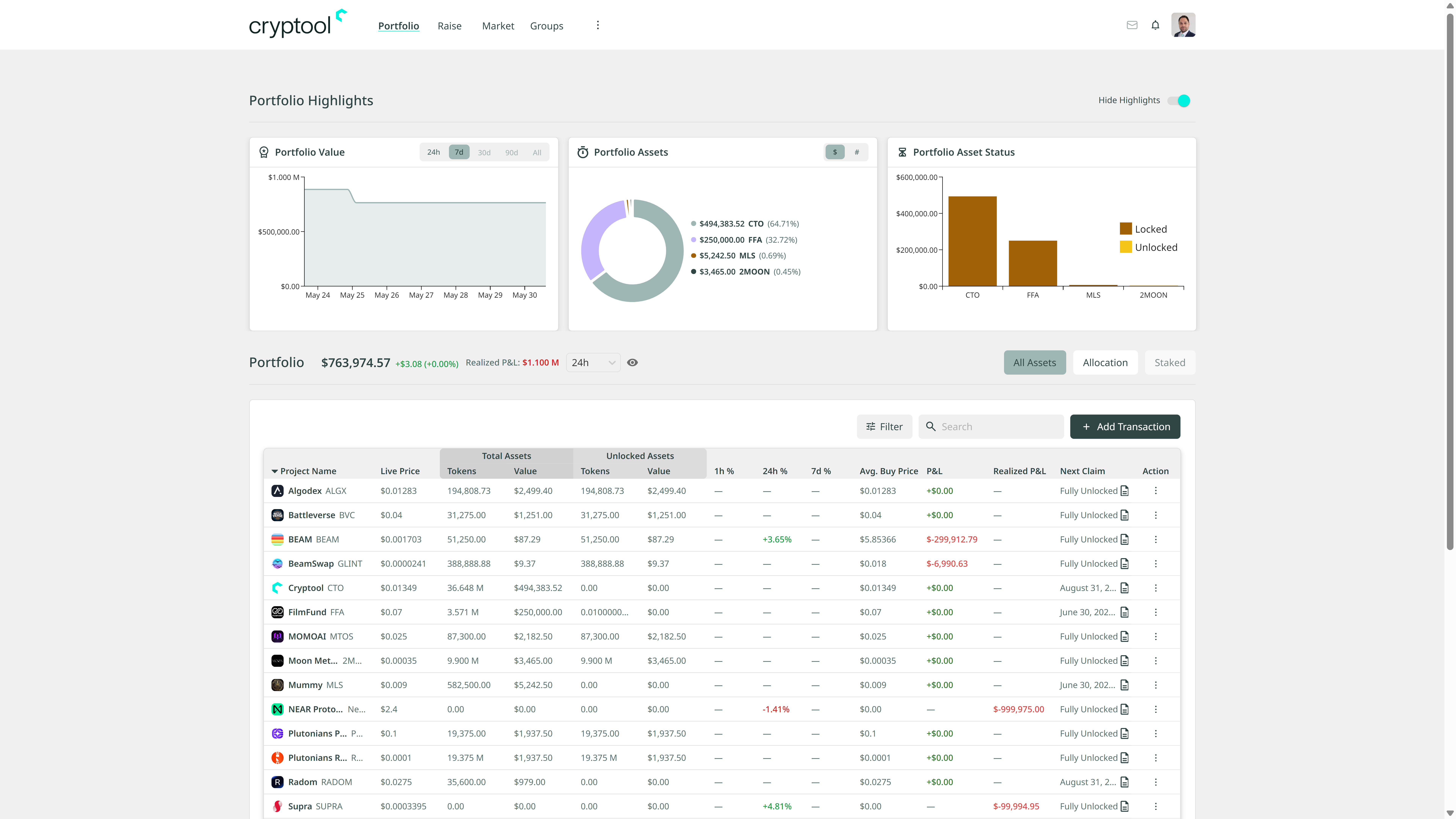
- Portfolio. Individual or group investments in one view: tokens, unvested allocations and custom assets, with P&L and ROI. Coverage spans all chains and all wallets for over 90% of platform features, with on-chain modules live on Ethereum, BNB Chain and MultiversX and more coming.
- Market. Members can trade allocations, partial or whole and even partially unvested, through public trading, broker sales or OTC execution between qualified counterparties.
All of it is non-custodial. Wallet connections are read-only by default, and Cryptool never holds private keys, funds or signing authority, and never takes ownership or control of investments.
One honest boundary
AngelList's product includes creating and administering the legal vehicle. Cryptool does not. Cryptool is software for running the raise, the allocations, the vesting and the distributions. It is not a broker-dealer, it does not create legal SPV entities, and it does not provide legal or tax structuring. Syndicates handle legal structuring separately with their own counsel, and use Cryptool to run the operational side on-chain.
Common questions
What is the best AngelList alternative for crypto syndicates?
Look for tooling that models what token deals actually require: member tiers, multi-stage raises, vesting and claim windows, automated on-chain distribution and multi-chain portfolio tracking. Cryptool is built specifically for that workflow, whereas equity-first platforms center on cap tables and legal vehicles.
Does Cryptool hold my syndicate's funds or keys?
No. Cryptool is non-custodial. Wallet connections are read-only by default, and the platform never holds private keys, funds or signing authority.
Does Cryptool replace the legal SPV?
No. Cryptool runs operations, not legal structure. Your syndicate sets up its legal entity and compliance separately, then uses Cryptool for members, raises, vesting and distributions.
What does Cryptool cost?
Plans start at Free for $0, For Users from $2.99/mo, For Advanced Users from $7.99/mo, Manager for VC and funds from $39.99/mo, and Enterprise from $119.99/mo. Full details are on the pricing page, or contact the team to talk through your syndicate's setup.

'%3e%3cpath%20d='M3.58464%2016.6693C3.1263%2016.6693%202.73394%2016.5061%202.40755%2016.1797C2.08116%2015.8533%201.91797%2015.4609%201.91797%2015.0026V5.0026C1.91797%204.54427%202.08116%204.15191%202.40755%203.82552C2.73394%203.49913%203.1263%203.33594%203.58464%203.33594H16.918C17.3763%203.33594%2017.7687%203.49913%2018.0951%203.82552C18.4214%204.15191%2018.5846%204.54427%2018.5846%205.0026V15.0026C18.5846%2015.4609%2018.4214%2015.8533%2018.0951%2016.1797C17.7687%2016.5061%2017.3763%2016.6693%2016.918%2016.6693H3.58464ZM10.2513%2010.8359L16.918%206.66927V5.0026L10.2513%209.16927L3.58464%205.0026V6.66927L10.2513%2010.8359Z'%20fill='%232F4644'/%3e%3c/g%3e%3c/svg%3e)


'%3e%3cpath%20d='M17.6986%203.85159L15.058%2016.3047C14.8587%2017.1836%2014.3392%2017.4024%2013.6009%2016.9883L9.57749%2014.0235L7.63608%2015.8906C7.42124%2016.1055%207.24155%2016.2852%206.82749%2016.2852L7.11655%2012.1875L14.5736%205.44924C14.8978%205.16018%2014.5033%205.00002%2014.0697%205.28909L4.85093%2011.0938L0.882175%209.85159C0.0188933%209.58205%200.00326826%208.9883%201.06186%208.57424L16.5853%202.59377C17.3041%202.32424%2017.933%202.75393%2017.6986%203.85159Z'%20fill='%232F4644'/%3e%3c/g%3e%3cdefs%3e%3cclipPath%20id='clip0_17601_246206'%3e%3crect%20width='17.5'%20height='20'%20fill='white'%20transform='translate(0.25)'/%3e%3c/clipPath%3e%3c/defs%3e%3c/svg%3e)