
How a Non-Custodial Model Changes Fund Administration
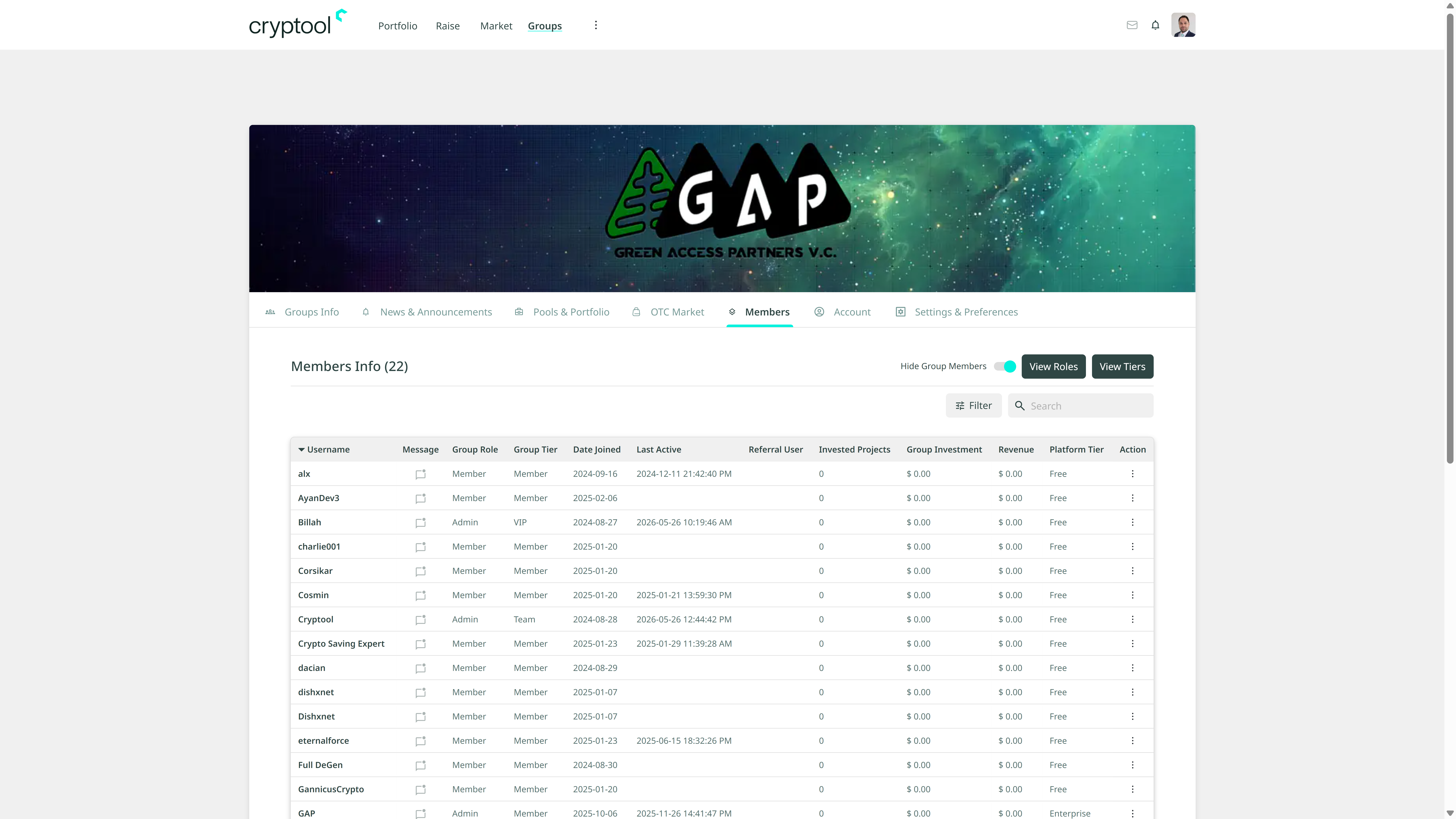
Community VCs and crypto syndicates share a common problem. They want to pool capital, track member allocations, and run distributions without handing their assets to a third party. Most traditional fund administration setups assume custody, which adds risk, cost, and a layer of trust the group never asked for. Non-custodial fund administration takes the opposite approach: the assets stay in the group's own wallets, and the platform handles the record-keeping and coordination around them.
Here is how that works in practice on Cryptool.
What non-custodial actually means
On Cryptool, wallet connections are read-only by default. The platform never holds private keys, never holds funds, and never has signing authority. Every transaction is signed by the user's own wallet directly, and Cryptool does not take ownership or control of any investment, per its published portfolio and raise terms.
For a community VC, that removes the biggest objection to using a fund administration tool at all. There is no platform account holding pooled capital, so there is no custody dispute to have and no third party to trust with the treasury. The group keeps its keys. Cryptool keeps the books.
Running a group without giving up control
Cryptool's Groups module is built for exactly this workflow. A syndicate lead can create and manage a group, add members, and organize them into up to 5 custom member tiers. Pools can be created and managed inside the group, and ROI and P&L are tracked per group, so the lead can see how each vehicle is performing without exporting anything to a spreadsheet.
The Portfolio module sits alongside it, giving a bird's-eye view of individual or group investments, including tokens, unvested allocations, and custom assets, with P&L and ROI indicators. Because coverage spans all chains and all wallets for over 90% of the platform's features, a syndicate holding positions across many networks sees them in one place.
Raises and distributions, still non-custodial
The part of fund administration that usually forces custody is the raise itself. Cryptool's Raise module handles it differently. A group can run multi-stage rounds with configurable caps, vesting schedules, and claim windows, with whitelist and KYC built in. Once the raise completes, distribution happens automatically on-chain. Groups using the Raise module set a group fee of at least 2%.
Vesting is defined by the admin at deal creation: cliff, duration, and unlock cadence. From there the platform does the follow-up work. Allocations are updated at least hourly, tokens are transferred to participants' wallets at each vesting unlock event, and the platform sends reminders when unlocks are due. That replaces the spreadsheet-and-calendar routine most syndicate operators know too well. For a closer look at that workflow, see [how crypto syndicates automate member allocations and distributions](/blog/how-crypto-syndicates-automate-member-allocations-and-distri).
On-chain modules are live today on Ethereum, BNB Chain, and MultiversX, with more networks on the way, including Polygon, Arbitrum, Avalanche, Optimism, and Solana.
What it costs
Cryptool's pricing is public. The Free tier is $0 and covers 1 wallet on 1 chain, enough to evaluate the platform. You can compare the current plans on the services and pricing page. The Manager plan is built for VCs and funds, and the Enterprise plan adds white label options, a custom group URL, and API integration. For a broader picture of how the modules fit together, read [crypto fund management in one place](/blog/crypto-fund-management-in-one-place-dealflow-raises-distribu).
Common questions
What is non-custodial fund administration?
It means the platform administers the fund's records, allocations, and distributions without ever holding the fund's assets. On Cryptool, wallet connections are read-only by default and every transaction is signed by the user's own wallet.
How does Cryptool keep assets secure in a non-custodial model?
Cryptool never holds private keys, funds, or signing authority, and it does not take ownership or control of investments. Assets remain in the wallets the group already controls.
Can Cryptool handle multi-chain fund administration?
Yes. Over 90% of the platform's features cover all chains and all wallets, and on-chain modules run on Ethereum, BNB Chain, and MultiversX today, with Polygon, Arbitrum, Avalanche, Optimism, and Solana coming.
How do participants track their vesting?
Allocations update at least hourly, tokens arrive in participants' wallets at each vesting unlock event, and the platform sends reminders when unlocks are due.
Non-custodial fund administration keeps control where it belongs, with the group. To see how it fits your syndicate, visit cryptool.io.


'%3e%3cpath%20d='M3.58464%2016.6693C3.1263%2016.6693%202.73394%2016.5061%202.40755%2016.1797C2.08116%2015.8533%201.91797%2015.4609%201.91797%2015.0026V5.0026C1.91797%204.54427%202.08116%204.15191%202.40755%203.82552C2.73394%203.49913%203.1263%203.33594%203.58464%203.33594H16.918C17.3763%203.33594%2017.7687%203.49913%2018.0951%203.82552C18.4214%204.15191%2018.5846%204.54427%2018.5846%205.0026V15.0026C18.5846%2015.4609%2018.4214%2015.8533%2018.0951%2016.1797C17.7687%2016.5061%2017.3763%2016.6693%2016.918%2016.6693H3.58464ZM10.2513%2010.8359L16.918%206.66927V5.0026L10.2513%209.16927L3.58464%205.0026V6.66927L10.2513%2010.8359Z'%20fill='%232F4644'/%3e%3c/g%3e%3c/svg%3e)


'%3e%3cpath%20d='M17.6986%203.85159L15.058%2016.3047C14.8587%2017.1836%2014.3392%2017.4024%2013.6009%2016.9883L9.57749%2014.0235L7.63608%2015.8906C7.42124%2016.1055%207.24155%2016.2852%206.82749%2016.2852L7.11655%2012.1875L14.5736%205.44924C14.8978%205.16018%2014.5033%205.00002%2014.0697%205.28909L4.85093%2011.0938L0.882175%209.85159C0.0188933%209.58205%200.00326826%208.9883%201.06186%208.57424L16.5853%202.59377C17.3041%202.32424%2017.933%202.75393%2017.6986%203.85159Z'%20fill='%232F4644'/%3e%3c/g%3e%3cdefs%3e%3cclipPath%20id='clip0_17601_246206'%3e%3crect%20width='17.5'%20height='20'%20fill='white'%20transform='translate(0.25)'/%3e%3c/clipPath%3e%3c/defs%3e%3c/svg%3e)